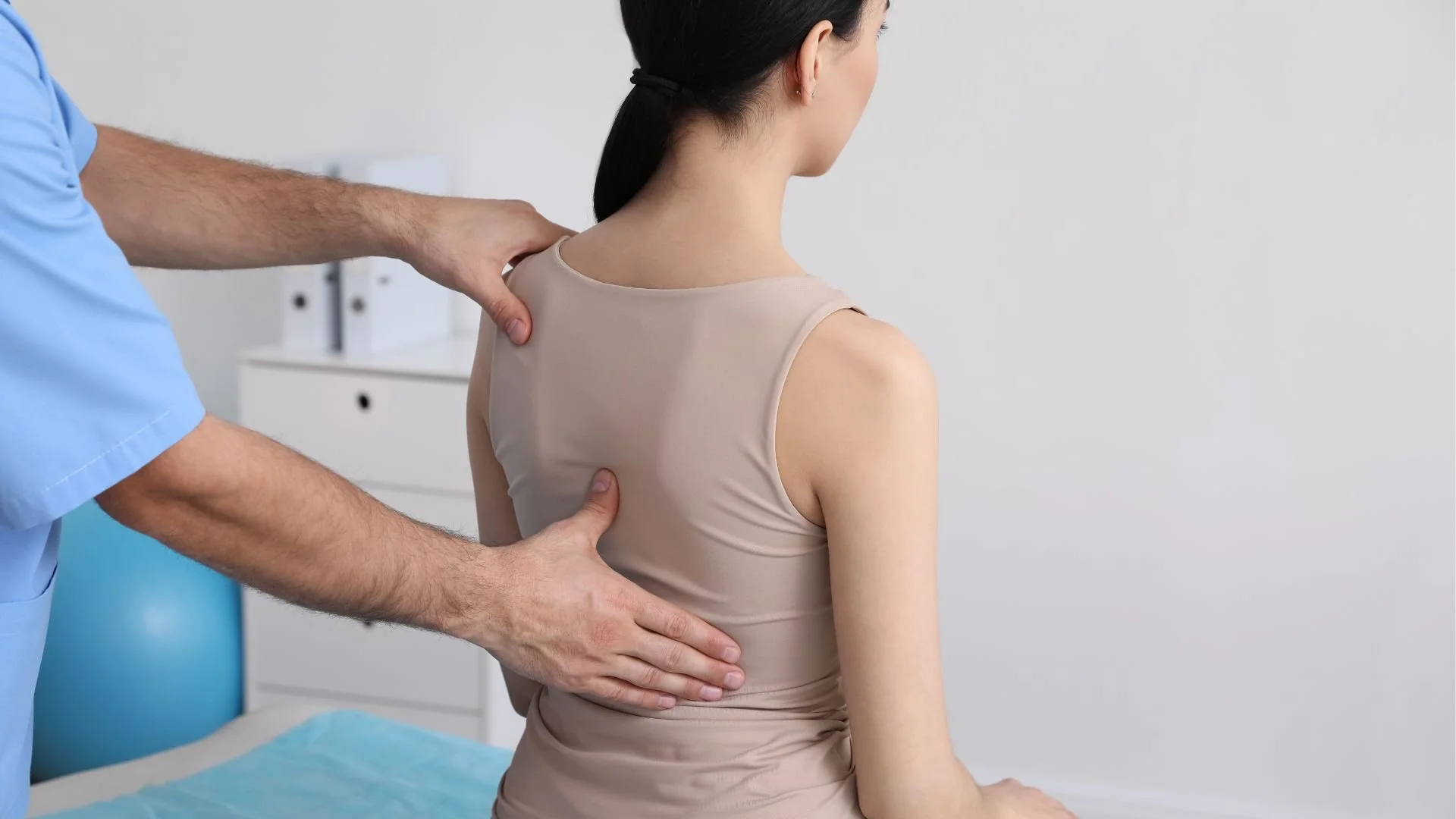
Being told that you have scoliosis raises a lot of questions at once. Is it serious? Did something cause it? Will it get worse? The reassuring part is that most curves are mild, and understanding yours is the first useful step. Scoliosis is a sideways curve of the spine with a twist through it, and it isn't caused by slouching or carrying a heavy bag. Physiotherapy for scoliosis cannot straighten a spine, so be cautious of anyone who says it can. It can help manage the curve, improve posture and movement, and ease the aches that uneven loading causes. For a growing child, it sits alongside monitoring by a doctor. For an adult, it often comes down to comfort and endurance through long workdays. Below, you will find what the numbers mean, what tends to help at each stage, and the signs worth acting on.
Rachel noticed it in a holiday photo: one shoulder sitting higher than the other, her waist uneven on one side. An X-ray her doctor arranged confirmed a mild curve, likely there since her teens and never picked up. Her first response was to fix it with willpower. She sat bolt upright in meetings and pulled her shoulders back whenever she remembered. By mid-afternoon she was tired, aching, and slumped back where she started.
What she had not realised is that a structural curve cannot be held straight by effort. The muscles around it have spent years adapting to its shape. The solution isn't forcing a position; it's teaching the body to balance and breathe well around the spine it actually has.
Is it scoliosis or just poor posture?
Poor posture is a position you can change by moving. Scoliosis is a structural curve, measured on an X-ray as 10 degrees or more, with a spinal rotation that doesn't disappear when you stand up straight. The two can look alike and often occur together, which is why a proper assessment matters before deciding what to do.
A common first check, and the one used in school screening, is the forward bend test. When a person bends forward with arms hanging, the rotation in a curve often shows as one side of the back sitting higher than the other. It is a screening sign rather than a diagnosis, but it explains why a curve can be hard to see when standing and obvious when bending.
It also helps to clear up two common myths. Scoliosis isn't caused by poor posture or heavy school bags, although a heavy bag can certainly cause backaches of its own. In most cases, especially in teenagers, the cause is unknown. That matters, because it means no one is to blame, and attention can move to what helps.
Can physiotherapy help scoliosis?
Within limits, yes. Physiotherapy will not straighten a curved spine, but scoliosis-specific exercises can help improve posture and trunk position and support quality of life. In growing children, they can form part of the plan to limit progression, alongside monitoring and, where needed, bracing. How much change is possible varies from person to person.
International guidelines describe a stepped approach based on curve size and remaining growth. Growth is the key factor. Curves are most likely to progress during growth spurts, and far less likely to change once growth is complete. Reviews of scoliosis-specific exercises, such as the Schroth method, report improvements in posture, trunk symmetry, and quality of life for many people, though results vary by individual and cannot be guaranteed.
What the numbers broadly mean
Under 10 degrees: usually described as spinal asymmetry rather than scoliosis.
10 to 25 degrees: a mild curve, often monitored, with specific exercise as an option.
25 to 45 degrees: in a growing child, bracing alongside exercise is often considered.
Above about 45 to 50 degrees: a specialist surgical opinion is usually sought.
These are general bands. Your doctor or physiotherapist will interpret your own measurement in context.
What does scoliosis physiotherapy involve?
It starts with understanding the curve: its size, where it sits, how flexible it is, and how it affects your breathing, balance, and daily positions. From there, a plan typically combines curve-specific exercises, breathing work to open the compressed side of the ribcage, and strengthening to help you hold better positions without strain.
These exercises are different from general fitness work. They are designed around the shape of your particular curve, which is why two people with scoliosis rarely follow the same programme. Practising them builds awareness, so that a more balanced position gradually becomes your default rather than something you have to force.
Daily habits matter too. For an adult like Rachel, the most useful changes are often small: shifting position regularly instead of holding one posture, setting up a desk that lets her move, and breaking up long stretches of sitting. For a teenager, staying active in sport is generally encouraged, with the exercises sitting alongside regular checks during growth.
Common questions about scoliosis
Q: Will exercises straighten my spine?
A: It is more realistic to think about managing the curve than straightening it. Scoliosis-specific exercises can help improve posture and trunk position and, in growing children, support efforts to limit progression. Physiotherapy does not promise to straighten a structural curve, and any promise of a specific result deserves caution.
Q: Is scoliosis always painful?
A: No. Many people with a mild curve have no pain at all and only notice it from an uneven shoulder or waist. When discomfort does appear, it is often a dull ache from uneven loading rather than from the curve itself. An assessment can tell whether the two are related and what tends to ease it.
Q: A school screening flagged a curve. What happens next?
A: In Singapore, school health screening checks for signs of scoliosis, and a flag is a prompt to have the spine assessed, not a diagnosis. The next step is a proper assessment, usually with an X-ray arranged by a doctor, to measure the curve and decide on monitoring, exercise, or referral. Early understanding gives the most options while a child is still growing.
When is it worth having your spine assessed?
Worth an assessment
A curve flagged at school screening or by a doctor that you want to understand.
Shoulders, hips, or waist that look uneven, or clothes that hang unevenly.
Backache linked to long periods of sitting or standing.
A curve that seems to be changing, especially during a growth spurt.
About BalanceCore
BalanceCore Physiotherapy & Wellness treats chronic and complex pain, scoliosis and posture, women's health, sports and running injuries, clinical Pilates, and foot care. Michael Yan, physiotherapist at BalanceCore in Marina One, developed the BalanceCore Method, which the whole BalanceCore team practises. Michael grew up in China with a grounding in Traditional Chinese Medicine philosophy, and holds a Master's degree in Musculoskeletal and Sports Physiotherapy from the University of South Australia. He has more than 27 years of clinical experience across a wide range of musculoskeletal conditions, and has been invited to teach fellow physiotherapists in Singapore, China, and Indonesia.
If you have been told about a curve, or you have noticed your posture sitting unevenly, understanding it is a calmer starting point than forcing yourself upright. An assessment looks at the curve, how you move and breathe, and where you are, then builds a plan around you. To explore scoliosis physiotherapy in Singapore, you can book an assessment with BalanceCore at Marina One.
References
Negrini S. et al., 2016 SOSORT guidelines: orthopaedic and rehabilitation treatment of idiopathic scoliosis during growth. Scoliosis and Spinal Disorders, 2018. ncbi.nlm.nih.gov
The effectiveness of Schroth exercises in adolescents with idiopathic scoliosis: a systematic review and meta-analysis. ncbi.nlm.nih.gov
PEDro, Systematic review: physiotherapy specific exercise approaches improved body posture, trunk deformity and quality of life in adolescents with idiopathic scoliosis. pedro.org.au
UVA Health, What Causes Scoliosis? (backpacks and posture do not cause scoliosis; most cases have no known cause). uvahealth.com
SingHealth, Adolescent Idiopathic Scoliosis: primary care. singhealth.com.sg
HealthHub Singapore (HPB), Health Screening for Secondary School. healthhub.sg